Two Full Dumpsters and Three Weeks of Work — A Hoarding Cleanout Case Study, Part 2
Two Full Dumpsters and Three Weeks of Work — A Hoarding Cleanout Case Study, Part 2
This is Part 2 of a four-part case study. Read Part 1 here — the call, the family, and what we found during our assessment.
The assessment was done. The plan was in place. Now came the work.
A Level 5 hoarding cleanout cannot be approached the way a standard junk removal job is handled. You cannot simply start hauling. Everything has to be sorted, assessed, and handled intentionally — or you risk discarding something irreplaceable and losing the family's trust in the process.
Here is how we executed this hoarding cleanup from start to finish.
Quick Answer
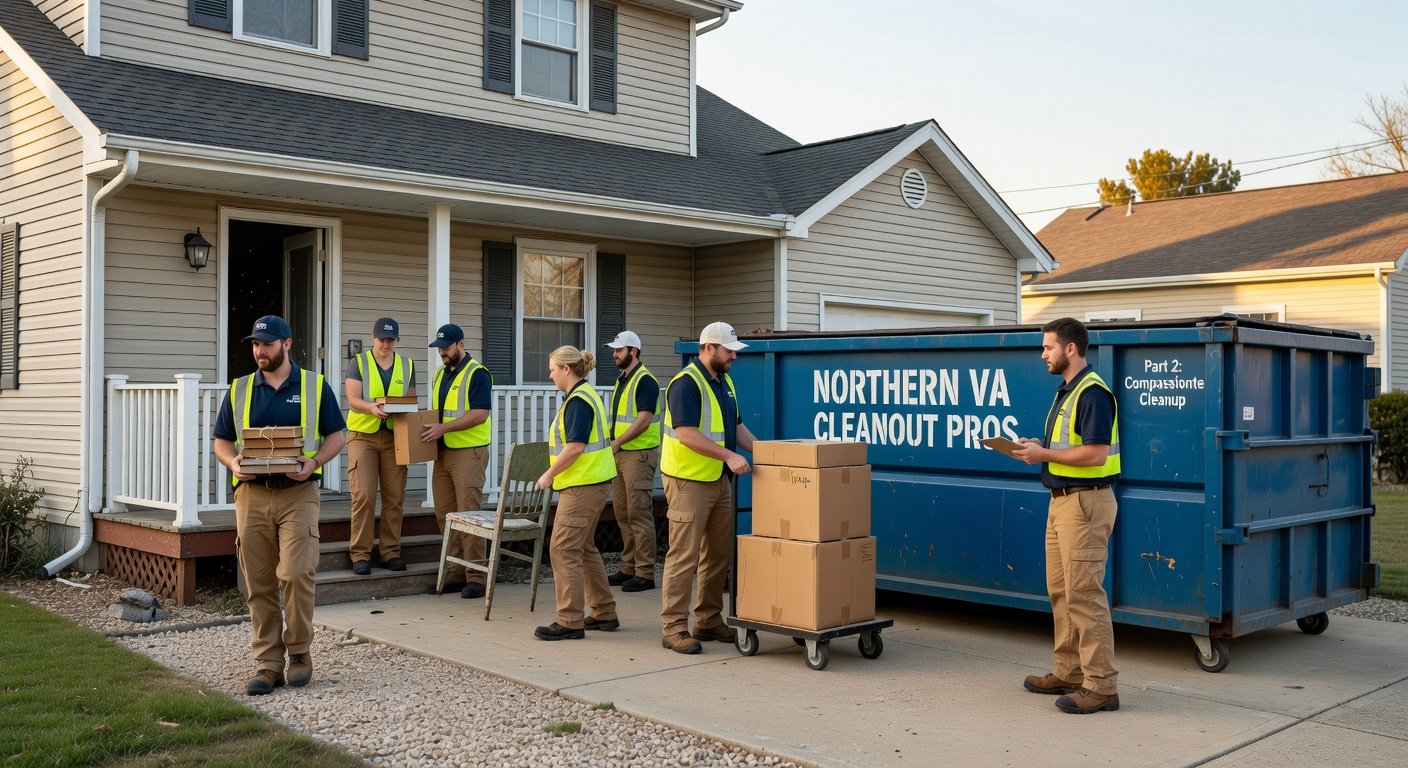
This cleanout required a crew of eight to ten people working for nearly three weeks. Two full-size dumpsters were filled completely. The basement mold, the four non-operational vehicles, and the sheer volume of every room required a structured, room-by-room approach with a dedicated preservation process running alongside the removal work.
Building the Right Crew for the Job
Our standard team was not large enough for a property of this scope. We brought in additional help, working with a crew of eight to ten people depending on the day.
On a job like this the crew is not just hauling — people are assigned specific roles:
- Sorting team — assessing every item before it moves, flagging valuables, making disposal decisions
- Hauling team — moving sorted items to the dumpster or to the preservation staging area
- Packing team — wrapping, boxing, and labeling everything being saved for the family
- Dumpster management — keeping the exterior organized and the workflow moving

Without that structure a job this size becomes chaotic. Coordination is everything.
Starting With the Biggest Hazard — The Basement
We always start with the area of greatest risk. In this case that was the basement.
A broken pipe on the interior well pump beneath the basement stairs had caused repeated flooding over the years. Books, boxes, and belongings stored under the stairwell had absorbed that moisture repeatedly. The result was significant white and gray surface mold — not black mold — concentrated heavily in that corner and spreading to surrounding items.
Our approach was methodical:
- Items with heavy mold coverage were bagged and disposed of safely — there is no practical way to restore heavily mold-damaged books and cardboard
- Items with light surface mold were assessed individually
- The entire area was cleared completely and documented for the renovation team that would follow us
- Crew members working in the affected zone used appropriate protective equipment throughout
Once the basement was cleared the rest of the home could be approached systematically from the ground up. This is a key part of our hoarder house cleaning process.
The Vehicles
Four non-operational vehicles on the property — three in the backyard, one in the front — were coordinated for removal as part of the overall job. None were in drivable condition. All four were arranged for junk vehicle removal and removed from the property.
This is something families often do not think about until they are standing in the middle of a cleanout realizing the yard is not actually clear. We handle it as part of the process.
What We Found That Stopped Us in Our Tracks
In the course of clearing the home we made a discovery that required us to pause.
The preserved remains of three of the couple's former dogs — boxed and kept — were found during the cleanout. We handled them with complete respect and dignity, set them carefully aside, and notified the grandchildren immediately. The family made the decisions about what to do with them.
Moments like this are a reminder that inside every hoarding situation is a human story. People, relationships, grief, and love — accumulated alongside everything else. Our job is never just to clear a space. It is to honor what that space meant to the people who lived there. This is what separates us from standard estate cleanup companies.
Three Weeks and Two Full Dumpsters
By the time the last room was cleared the final count was:
- Nearly three weeks of active work
- Eight to ten crew members on site daily
- Two full-size dumpsters filled completely
- Four vehicles removed from the property
- Dozens of labeled boxes of valuables and preserved items staged for the family
Every room — the bedrooms, the bathrooms, the kitchen, the living areas, the garage, the shed, and the basement — was empty and clean.
The home that had been a Level 5 hoarding situation two and a half weeks earlier now had visible floors, empty rooms, and open space for the first time in years.
In Part 3 we talk about the part of this job that required the most care — the collections. A lifetime of coins, baseball cards, records, and collectibles that needed to be identified, preserved, and returned to the family. Know when it's time to call a professional.
If your family is facing a situation like this one, contact us or call us at 540-538-7092 for a free, no-pressure consultation. We serve Woodbridge, Prince William County, Stafford, Fredericksburg, Spotsylvania, Orange County, Caroline County, King George County, and Fairfax County.